Rancho Compasión: A Farm Animal Sanctuary for West Marin Families
 Jessie Feller
Rancho Compasión began in 2015, when Miyoko and Michael Schinner adopted two goats and gave them a home in the rolling hills of Nicasio. What started as one family's quiet act of care grew into a nonprofit farmed animal sanctuary that today provides a lifelong home to more than one hundred rescued residents across twelve species, among them pigs, cows, goats, sheep, chickens, ducks, geese, and donkeys. The sanctuary's mission, in its own words, is "to provide a loving, lifelong home for rescued farmed animals" and to model a compassionate, sustainable way of living for animals, people, and the planet alike.
That mission traces back to the founder, Miyoko Schinner, an award-winning chef, cookbook author, faculty member at UC Berkeley's Haas School of Business, and the founder of Miyoko's Creamery. "I truly believe we change the world by nurturing compassion and love," she told The Community Voice. At Rancho Compasión, that belief takes the form of daily practice, where animals many people only ever meet on a plate live instead as individuals with names, histories, and personalities.
The name carries a piece of local history too. Nicasio sits on the ancestral land of the Tamal Coast Miwok, and the surrounding valley was once folded into an 80,000-acre spread known as Rancho Nicasio. In choosing "Rancho Compasión," Spanish for compassion ranch, the founders describe a deliberate wink at those old ranch names, a way of reimagining what a ranch in west Marin can be. Ten years on, the sanctuary marked the milestone in 2025 with a "Cirque du Sanctuary" anniversary gala, a sign of how deeply the community around Nicasio has come to hold it.
Kids Classes in Marin County: Year-Round Days on the Land
Beyond its Saturday tours, Rancho Compasión runs a year-round youth education program called Friends & Food, and it is where the sanctuary's classes for kids live. During the school year, children ages 6 to 12 join the After School Enrichment program, spending one afternoon a week on the property in eight-week sessions. Among kids classes in Marin County, few of them unfold across seventeen acres of open land, garden beds, and animal habitats.
Here is a sense of what a season in the program looks like:
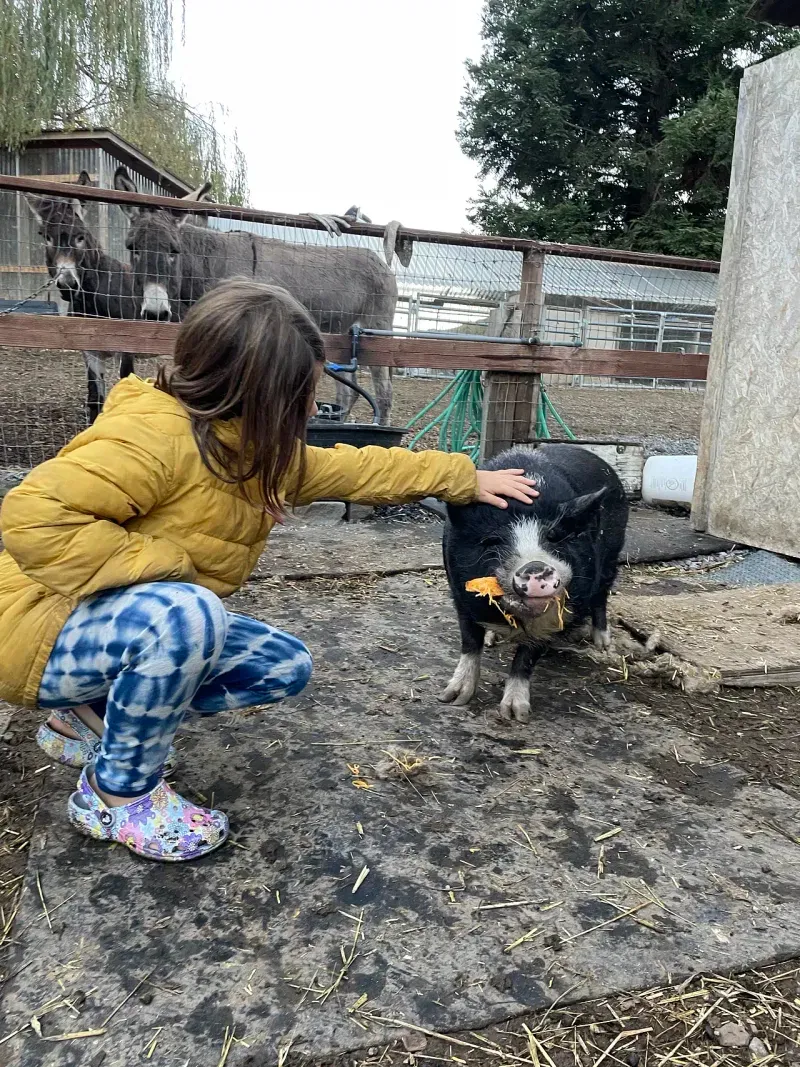
- Animal care and bonding. Children help with feeding, chores, and gentle, staff-guided time among the residents. The sanctuary is clear that it is not a petting zoo. Kids learn to read an animal's cues, keep their voices low, and let a goat or a goose decide whether to come closer, an early lesson in respecting another being's agency.
- The Compassion Garden. In a half-acre organic garden, kids plant, tend, and harvest food that feeds both the animal residents and the shared table, watching a bed of seedlings turn into a real meal over the weeks.
- Garden-to-table learning. Children forage on the property and trace where food actually comes from, connecting what grows in the ground to the health of the land around them.
- Arts, crafts, and open discussion. Between chores and garden time, the day makes room for making things, talking through big ideas, and sharing what they notice, guided by the natural curiosity of young minds.
Because the program runs one day a week across two months, families see the garden and the seasons shift over a session, and single-day drop-ins are available for families who want to try a day before committing to the full eight weeks.
Kids Camps in Marin County: A Summer at the Sanctuary
When summer arrives, the sanctuary becomes one of the more distinctive kids camps in Marin County. Rancho Compasión Summer Camp welcomes children ages 5 to 12 for weeklong sessions that run mornings into early afternoon on the same seventeen acres. Days blend hands-on animal care and bonding, nature exploration, plant identification walks, improv and mindfulness games, and creative workshops, with visiting guest speakers from groups like WildCare and All About Owls. A fresh organic lunch and two daily snacks, many of them grown right in the garden, are part of every camp day.
Older kids have a place here too. Teens ages 13 to 18 can join as counselors-in-training, helping staff set up and lead activities, keeping an eye on younger campers, and taking on chores and projects shaped around their own goals. It is a real apprenticeship in leadership, animal care, and gardening, set outdoors across a full summer, and a natural next step for a younger camper who has aged up but is not ready to leave the sanctuary behind.
What ties the classes and the camps together is the sanctuary's founding idea, that how we treat animals, grow food, and teach children are all connected. "We are all part of the same planet," Schinner told The Community Voice. "We share it with other species as well. It is their planet too." For many campers, a week at Rancho Compasión is their first time meeting a cow or a pig outside of a fence line, and the encounter tends to reshape how they think about the animals and the land around them.
An Accessible, Welcoming Place for Families
Access is built into how Rancho Compasión operates. Every summer camp week offers a sliding-scale tuition option alongside full tuition, because, as the sanctuary puts it, "access to nature, animals, and outdoor learning should be available to more families." Siblings registered together for the same session receive a one-time discount, and single-day drop-ins give families a lower-commitment way in. Every camper is fed on-site with a fresh organic lunch and two snacks at no extra cost, so there are no packed lunches to worry about on a busy morning.
A few practical notes help families arrive prepared. The property is a working sanctuary, so kids come in sturdy closed-toe shoes and clothes that can get muddy and dusty. And because the animals' wellbeing comes first, the whole property is a fully vegan space, with all camp food provided on-site so every child eats the same compassionate meals together. On Saturdays, the sanctuary opens its gates to the public free of charge, an easy way for a curious family to walk the land and meet the residents before ever signing up for a program. Families with questions about the youth programs can reach Heather LeGrand, who coordinates education at the sanctuary, and the staff are happy to help a new family figure out which program fits their child.
Rancho Compasión lists its summer camps, after-school sessions, and teen counselor programs on Enrichment.kids, where families can see what is coming up, filter by age, and register in a few clicks. The listings stay current, so parents do not have to dig through emails to find the next open session.
Where Compassion and Community Flourish
What lingers after a day at Rancho Compasión is a feeling as much as a memory: the hush that settles over a group of kids when a rescued goat finally decides to lean in, the pride of carrying a basket of garden greens to a hungry pig, the quiet understanding that these animals are somebody, not something. Children leave having practiced patience, gentleness, and care, and parents leave having watched their kids extend that care to the land and the creatures on it.
Compassion, curiosity, accessibility, connection, community, Rancho Compasión embodies all these values for Marin County parents and kids. If your family loves animals and the outdoors, or you are simply looking for a place where your child can slow down and pay attention to another living thing, the gates in Nicasio are open on Saturdays and the programs run all year. Come walk the hills, meet the farmily, and see what it feels like to spend a day where care is the whole point.