Sunbeam Nature School: A Two-Acre Farm School for Petaluma Families
 Jessie Feller
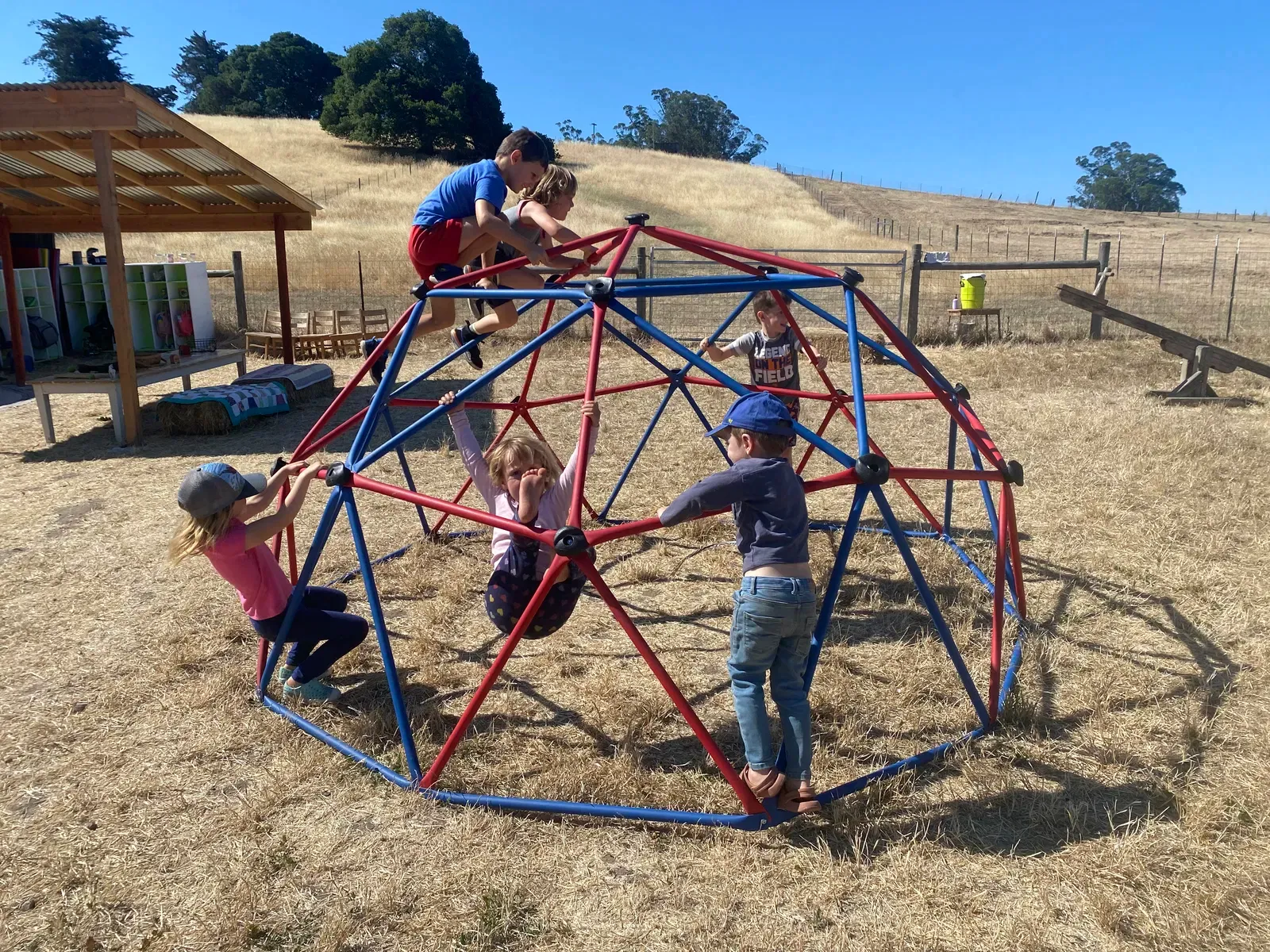
Sunbeam sits at 1002 Bodega Avenue, a few minutes from downtown Petaluma and a world away from a fluorescent-lit classroom. It is a working farm and a living lab school at the same time. Children grow food, tend animals, build with loose parts, and spend nearly every hour of the day under open sky. For North Bay parents looking for kids classes in Petaluma that do not involve sitting still, Sunbeam is one of the most distinctive options in Sonoma County.
A Working Farm with a Heart for Community
Sunbeam began in 2020, in the middle of a year when nothing about school made sense. Founding director Shawna Thompson started it with what the school describes as "a clear and courageous vision: to offer children and families a safe, healing, and joyful outdoor learning experience during a time of cultural uncertainty and disconnection." What started as a response to crisis, the school says, "has since grown into a thriving, interconnected community rooted in nature, justice, and care."
Shawna is not new to this. She is a mother of two with more than 25 years working with children, a founding teacher at several of San Francisco's early childhood programs, a contributor to two published books on early childhood education, and co-author of a forest preschool startup handbook and training manual.
The school's name comes from a specific afternoon in the spring of 2011, when Shawna was teaching in the fog of San Francisco's Presidio. A five-year-old drew an idea in her journal, a dreamcatcher-like design she called a "Sun Trap," meant to pull sunshine into the dim sun porch next to their classroom. The class formed a Sun Trap Committee, hunted for "the friendliest materials for the sun," and built a sculpture out of an upturned umbrella strung with shimmering, translucent treasures. Years later, when Shawna imagined a school of her own, Sunbeam was the name that fit.
That story tells you what to expect. Sunbeam is a nonprofit, license-exempt cooperative school and camp that welcomes families of all backgrounds, identities, and abilities, and that acknowledges its campus sits on the ancestral lands of the Coast Miwok people.
Kids Classes in Petaluma: Learning That Happens Outside, in Every Season
Sunbeam runs year-round programs rather than a single seasonal offering, so families can find a rhythm that fits their week. The Morning Program meets Tuesdays and Thursdays and serves two age groups, 2 to 4 (with a grown-up participating alongside) and 4 to 8. The Afternoon Program runs Tuesday through Friday for ages 4 to 7 and 8 to 12, and because Sunbeam is close to Valley Vista Public Waldorf, there is an optional pickup and walk-over from that campus for families who find it useful. The two afternoon groups even have their own names: the Barn Swallows and the Ravens.
What actually fills those hours comes down to a handful of curricular pillars:
- Physical play and loose parts. Big open space, plus mats, hay bales, crawl-through tubes, tires, and PVC pipes that children move themselves. Ramps become physics experiments, channels get built to move water, and the big hill gets climbed for tree climbing, long views, and foraging wild greens.
- The mud kitchen. Sunbeam calls it the heart of the play yard, and it earns the title. Children mix, grate, sprinkle, and pour for long stretches, testing volume and negotiating turns. One child has spent months refining a process for making drip coffee out of a strainer, a funnel, and a tube.
- Creative projects. Art materials are offered in response to what children are already noticing. When the swallows return to their mud nest in the barn each June, watercolor portraits appear, and children study the birds' features and wonder aloud about migration while they paint.
- Garden and kitchen. An organic vegetable and flower garden that children tend from seed to sprout to harvest to compost, plus a garden-inspired cooking project once or twice a week that turns what they grew into a shared snack.
- Animals. Chickens, guinea pigs, sheep, and lambs are cared for daily. Children learn to read nonverbal cues, observe life cycles, and practice the kind of patience that comes from another creature depending on you.
- Farm Stand Fridays. Beloved by the older children, who harvest greens, herbs, vegetables, eggs, and fruit, then cut and bundle it, arrange bouquets, set their own prices, make their own signage, and sell to neighbors. The proceeds go back into seeds and supplies for the garden.
Underneath all of it is a philosophy drawn from Reggio Emilia, forest school, Waldorf, and Montessori practice, and a stated goal that each child comes away with "an image of themselves as competent, wise, strong, and capable of taking risks."
Kids Camps in Petaluma: School Breaks Spent on the Farm
Sunbeam's seasonal day camps are where a lot of Petaluma families meet the place for the first time. Among kids camps in Petaluma, these run on an unusually simple premise: give children a whole day outdoors, and then get out of the way. Camps run during fall, winter, and spring breaks as well as each summer, grouped roughly by age (3 to 7 and 8 to 12), with fall through spring sessions running longer into the afternoon and summer days wrapping mid-afternoon. Groups stay small, generally twelve to fourteen children, and before-care and extended-care hours are available for parents whose workday does not end at two.
The camp itself is described as "the outdoors, un-rushed childhood at its best," and the approach is play-based, consent-based, and nature-immersed. Children have the entire camp day to move, imagine, and play with friends. There is gardening, there are visual and sensory art materials, there are loose parts and tinkering supplies, and there is the daily work of tending guinea pigs and chickens with careful supervision. Staff ask children to stay aware of their own needs and the needs of others in the group, with the goal of a safe, connected, and inclusive community.
For parents used to camps built around a themed schedule, this can take a minute to absorb. Sunbeam's answer is that the children already know what to do. As Shawna puts it: "At Sunbeam, we trust in the power of children's intrinsic motivations. We acknowledge that they are already equipped with the best tools for learning: their curiosity and imagination. Our learning is hands-on, and always growing from what matters most to the children themselves."
It is also worth knowing, before you pack a bag, that Sunbeam means it about being outdoors. Only a short list of conditions keeps the group fully inside: smoky air, days over 90 degrees, winds over 35 miles per hour, and thunder and lightning. Rain is not on that list. Winter at Sunbeam means wool or poly base layers, waterproof shells, hats, mittens, and spare socks, and it means streams for floating boats and puddles that become the dominant texture of the campus. Parents who send their children in the right layers tend to report the rainy weeks are the ones their kids talk about most.
An Accessible, Affordable Resource for Families
Sunbeam is unusually transparent about money, and that transparency is itself the access story. Rather than a single price, most sessions are offered in tiers named for the life of a plant: Bud, Blossom, Flower, and Fruit. Each tier is labeled with what it actually pays for. Bud covers the bare minimum of operating costs and is explicitly reserved for a share of enrolled families who need it. Blossom covers staff wages and basic operations. Flower adds supplies and materials. Fruit, as the school describes it, "allows us to offer further discounts to families of need" and to invest in staff wages and the campus. Families choose the rate that matches their situation, and no one has to explain themselves at the door.
Beyond the tiers, sliding-scale rates are available for eligible families, arranged directly with Shawna by email. Siblings enrolled in the same session at the same time receive a discount. Drop-in and trial sessions let a family try an afternoon before committing to a term. As a nonprofit, Sunbeam also fundraises to keep the whole structure standing.
Practical browsing is where Enrichment.kids can save you some time. Sunbeam's camps, afternoon program, and morning sessions are all listed there, so you can filter by age and date, see what is running when, compare the tiers side by side, and register in a few clicks rather than emailing back and forth about the schedule. It is a small convenience, but for a parent piecing together a fall of school breaks, it is a useful one.
Where Curiosity and Community Flourish
What stays with families about Sunbeam is not the curriculum language. It is the sound of the place: a dozen children negotiating over the mud kitchen, a rooster somewhere behind the barn, someone shouting about a frog. Children here are trusted to take real risks, handle real tools, care for real animals, and follow an idea for as long as it holds them. Grown-ups are folded in too, through the morning co-op, through tours, through the Friday farm stand where a seven-year-old will sell you a bundle of chard.
Inspiration, affordability, accessibility, creativity, community, Sunbeam Nature School embodies all these values for Petaluma parents and kids. If your child is happiest with dirt under their fingernails, or if you have been quietly wondering whether there is a version of school where that is the point, this is a place worth seeing for yourself. Browse the upcoming classes and camps on Enrichment.kids, or schedule a tour and walk the hill up to Grandmother Oak. You will get a fast and honest answer about whether it fits your family.