The Floathouse Petaluma: Learning to Row, Paddle, and Sail on Petaluma's Longest Park
 Jessie Feller
A Rivertown Nonprofit with a Heart for Community
The Floathouse sits at 50 Water Street, on 160 feet of low dock anchored to seven fiberglass pilings in the middle of downtown Petaluma. It is a project of the Petaluma Small Craft Center, a 501(c)(3) nonprofit founded in 2007 by a coalition of people who loved small boats and wanted the river opened up to everyone else. Programming started in 2009 with community events and boating summer camps, run for years off borrowed docks near the Petaluma Yacht Club. The Floathouse itself did not open until October 2022, after more than a decade of community fundraising.
The organization's executive director, Greg Sabourin, helped found both the North Bay Rowing Club in the early 1980s and, later, the Petaluma Small Craft Center. He traces the whole thing back to one decision made after college. "I had enough money to buy a car or a boat," he writes on the organization's crew page. "I bought the boat, and that began my affair with the Petaluma River."
That affection runs through the whole board. Sue Pearson spent six years with the summer camps teaching kids to paddle a six-person outrigger canoe. Craig Caddell co-founded River Town Racers, a local sprint kayak club. Jean Dunham found rowing as an adult through the North Bay Rowing Club and now serves as vice president. The center calls the waterway "Petaluma's Longest Park," a linear park that begins in the heart of the city and runs out through the tidal marshes to the bay, and the phrase is the clearest statement of what the place is for.
Kids Camps in Petaluma: A Week on the River
Among kids camps in Petaluma, The Floathouse offers something no one else in Sonoma County can: a week spent learning to move a boat by hand, right through the middle of town. Two camps run on alternating weeks each summer, both capped at six campers.
- Small Boat Summer Camp (ages 10 to 14). Five mornings, Monday through Friday, 9 a.m. to 1 p.m. Campers work through the whole fleet: paddle and pedal kayaks, canoes, stand-up paddleboards, and three kinds of rowboats. No prior experience is needed.
- Intro to Sailing Camp (ages 10 to 17). Four afternoons, Monday through Thursday, 1 p.m. to 4 p.m., timed for the hours when the Petaluma Gap winds fill in. Campers learn on radio-controlled sailboats, El Toros, a Captain's Gig, and a Lido-14, working with the wind and tides inside the sheltered turning basin.
- Outings with the local clubs. Small Boat campers paddle a six-person outrigger canoe with Kai Wai Northbay Outrigger Canoe Club and try sprint kayaking with River Town Racers, meeting the adults who row and paddle these waters year-round.
- A wetlands walk. Every Small Boat session includes an exploratory nature walk through Alman Marsh or Shollenberger Park with the Petaluma Wetlands Alliance, so the week connects the boat to the watershed it floats on.
- Mess About in Boats Day. The last day of Small Boat camp, when campers are told to bring a swimsuit and a towel. Most, according to the camp's own description, cannot help but dive right in.
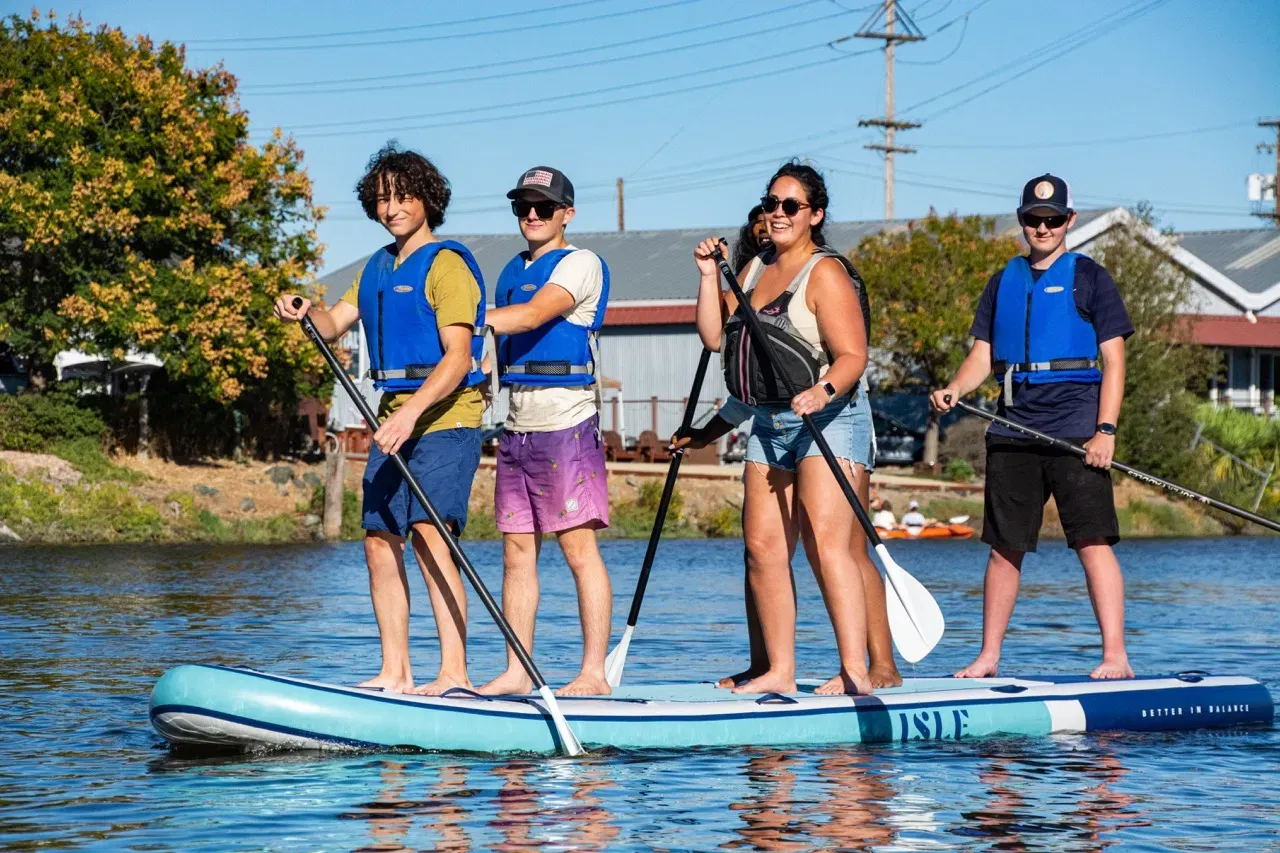
The fleet is the unusual part. The Floathouse keeps close to sixty people-powered craft on three boat racks, including Adirondack Guide Boats, Whitehalls, Hydro Bikes, high-end Schiller water bikes, and a giant paddleboard called the Megalodon rated to hold a thousand pounds. Families often enroll a child in both camps across the summer so they get through the entire fleet.
Board member Miki Romo, an occupational therapist who teaches stand-up paddleboard yoga at the docks on weekends, describes what she watches happen out there. "Something magical happens when people get out on the river and interact with nature and water," she writes. "Perspectives shift and moods lift. Often, there is a realization that the river was here all along, waiting to be enjoyed by the community that it runs through."
Year-Round on the Water in Petaluma
The camps are the heart of what The Floathouse offers children, but the docks stay busy the rest of the year, and much of it is family-friendly. The center is open Thursdays and Fridays from 10 to 3 and weekends from 9 to 5, renting out the same fleet the campers learn on, with memberships available for families who come often. Turn to the River, the center's guided paddle tour, takes visitors out from the basin toward the marshes with someone along who can name what you are looking at. Saturday morning SUP Yoga, a collaboration with The Yoga Post Petaluma, has been running since 2022. Custom group experiences can be booked for birthdays and gatherings.
For parents already sorting through kids classes in Petaluma, this is a useful thing to know: a family can rent two kayaks on a Saturday and find out whether a child actually likes being on the water before committing to a week of camp. It is a low-stakes way in, and it is the same dock, the same staff, and the same river.
There is more coming. The Floathouse is the first piece of a larger plan that includes a separate Community Boathouse, which would house Petaluma's rowing and outrigger clubs and their longer boats. The center works alongside He'e Nalu, Ohana Wa'a, Lokahi, Kai Wai, the North Bay Rowing Club, River Town Racers, Clavey Paddlesports, and the Sonoma State crew team, and several of those clubs would make their home there.
An Accessible, Affordable Resource for Families
Access is the organization's stated reason for existing. Both the Small Boat and Intro to Sailing camps are priced in line with what North Bay families see for a week of specialized instruction in the region, and a 10 percent discount applies when siblings or friends register together in the same session. The cancellation policy is fair in a way that matters to parents: full refund or credit if the center cancels for weather, full refund or credit if you cancel more than seven days out, and if you cancel later than that you may send another camper in your child's place.
The wider mission is broader than the camps. The Coastal Conservancy's Ann Buell, writing in support of the project, made the case plainly: a rental center downtown "would serve those who don't own their own boat or paddle board, or who don't have the means to store or transport a boat or board to a launch site." That is most families. The Floathouse also lets anyone who does own a people-powered craft launch and land from its docks, subject to space, and it runs a volunteer program for people who want to be around boats without paying for the privilege.
Both camps are listed on Enrichment.kids, where you can see the session dates side by side, filter by your child's age, and register in a few clicks. The Floathouse itself was funded almost entirely by neighbors, with sections of dock, life vests, and individual boats purchased by local families through the center's naming program.
Where Confidence and Community Flourish
What stays with parents is usually not the boat. It is watching a ten-year-old who has never held a paddle come back to the dock steering straight, or a teenager reading the wind on their own for the first time in a boat small enough that every decision is theirs. The river runs through the middle of Petaluma, past the grain mills and the turning basin, and most kids grow up looking at it without ever getting on it. A week here changes that permanently.
Curiosity, access, skill, stewardship, community: The Floathouse Petaluma embodies all these values for North Bay parents and kids. If your family has been driving over the D Street bridge for years wondering what it would be like down there, the docks are open Thursday through Sunday, and the summer camp sessions are listed on Enrichment.kids and on the center's own site. Rent a kayak some Saturday, paddle out past the turning basin, and see what your kids make of it.