Umbel Roots Farm: A Working Organic Farm Welcomes Petaluma Kids
 Jessie Feller
Imagine a place where your child kneels in a sun-warmed field, presses a seed into the soil, and a few weeks later comes back to find a row of green shoots they put there themselves.
That place is just off Sears Point Road, in the rolling hills where Sonoma meets Marin. Umbel Roots Farm is a certified organic, biodynamic working farm that supplies some of the Bay Area's best restaurants, and each summer it opens its rows and greenhouses to a small group of Petaluma kids. For North Bay families looking for a camp that isn't just outdoor day care, Umbel Roots offers something rarer: a real farm, real farmers, and a real chance for kids to live the rhythms of a growing season.
A Working Farm with Room for Curiosity
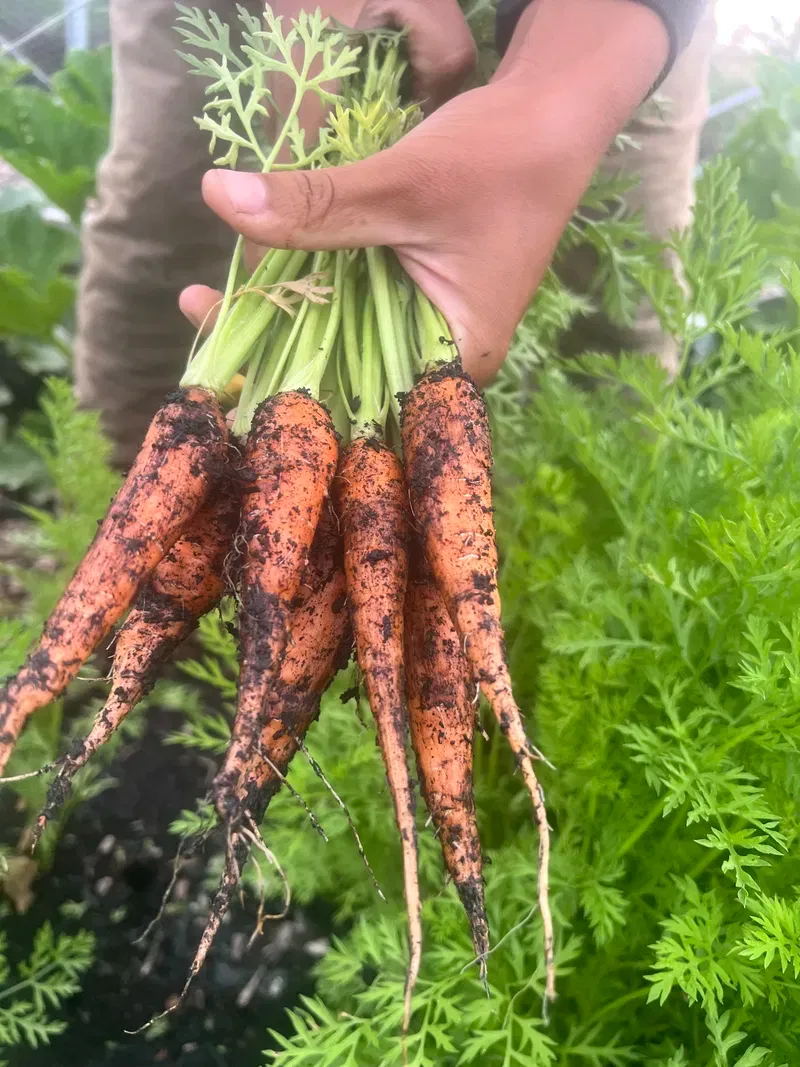
The story of Umbel Roots starts with one farmer's second act. Founder William Henpenn spent decades as a chef, restaurateur, and sommelier, working in Michelin-starred kitchens in New York and running his own restaurants in Portland before settling in Sonoma County. In late 2023 he leased a patch of long-fallow pastureland off Highway 37, and in less than a year he had transformed it into a thriving no-till farm growing more than 500 varieties of greens, vegetables, herbs, medicinal plants, and edible flowers.
Today, Umbel Roots is certified organic by California Certified Organic Farmers (CCOF) and working toward biodynamic certification from the Demeter Association. The farm uses no-till methods, brews its own compost teas in place of synthetic fertilizers, and sets aside ten percent of its acreage purely for pollinators and biodiversity. Henpenn describes the goal plainly: to grow "the best possible, most flavorful vegetables, fruits, edible flowers one can possibly grow," and to do it in a way that respects the land and the people who work it.
The farm's name is itself a small botany lesson. An "umbel" is the umbrella-shaped flower cluster you see on fennel, carrots, and parsley, where every stalk springs from a common center. Henpenn, who has a flowering fennel bulb tattooed on his calf, chose the name as a nod to his favorite plant and to the idea that good things grow out from a shared root. It's a fitting metaphor for what happens when the farm becomes a classroom.
Kids Camps in Petaluma: A Real Farm Experience for Ages 6 to 12
The flagship offering for families is the Summer Camp at Umbel Roots, an immersive day camp built for children ages 6 to 12. It's the kind of program parents in the Petaluma area have been quietly hoping someone would put together: not a craft table on a lawn, but a working farm where kids actually do the work that makes food happen.
Camp runs Monday through Friday, 9:00 a.m. to 1:00 p.m., across three week-long sessions in June. Group size is intentionally small, capped at twenty-five kids per session, which gives the camp the feel of a tight cohort rather than a crowd. Each day blends hands-on farm tasks with art and play, and the whole program is taught in both Spanish and English, an approach that will feel familiar to families connected to Petaluma's dual-language community.
A typical week at Umbel Roots includes:
- Planting and gardening. Kids learn how to start seeds, transplant seedlings, weed responsibly, and tend a growing bed from one week to the next. They handle real farm tools, sized and supervised for safety, and learn what each one is actually for.
- Animal care. Campers feed the chickens, collect eggs, and meet the rest of the farm's working animals. For a lot of kids, it's the first time they've held an egg that was warm an hour ago.
- Arts and crafts on the land. Pressed-flower projects, nature drawing, and craft work using materials gathered from the farm itself give the day an artistic rhythm to balance out the physical work.
- Bilingual learning, woven throughout. Instructions, plant names, and songs move between Spanish and English over the course of the day. Kids who are already bilingual deepen their vocabulary; kids new to Spanish pick up natural, in-context language they wouldn't get in a classroom.
- Friday farm-fresh pizza. Every Friday, campers gather what they've grown, build their own pizzas from scratch, and bake them. It's a small ritual, and parents who pick up on Friday afternoon usually hear about it for days.
What sets the camp apart is the team running it. The program was designed by two experienced elementary-school teachers from Loma Vista Immersion Academy, Petaluma's K-6 Spanish/English dual-language public charter, both of whom lead camp alongside Farmer William. One of the teachers is also a Loma Vista parent, which has made the camp feel like a natural extension of the local school community from day one. Kids whose families are already part of that bilingual world will find familiar faces and familiar rhythms. Kids new to it will be welcomed in.
Because Umbel Roots is a real working farm, campers see what a real working farm looks like. Some mornings they might walk past Farmer William in a greenhouse, hands deep in soil, choosing the day's harvest for a chef at SingleThread or Quince. The food world that supplies wine-country tables isn't kept behind a curtain, it's part of the day.
A Camp Built on Specific Values
Umbel Roots has a way of describing how it operates that reads more like a code than a marketing line: "We treat people consistently, and apply our ethos and values consistently. We are reliable, delivering on our commitments, living our values, and holding ourselves and each other accountable. We are honest, aware and open about our limitations and areas of opportunity, and we welcome hard conversations, doing the right thing even if it's not easy."
That's an unusual paragraph to find on a kids' camp page, and it matters. The camp inherits the farm's culture, and the farm's culture is hands-on, honest, and patient with kids the same way it's patient with soil. When something doesn't work, you figure out why. When you make a commitment, you keep it. When a chicken gets out, you go catch it.
The same farmer's mindset shapes the practical side of the camp. Children wear closed-toed shoes on the farm, bring a sun hat and a water bottle, and pack their own lunch (with Friday's pizza as the happy exception). Tuition for a week-long session is $325, and Umbel Roots offers a five percent discount per participant when families register two or more kids in the same session at the same time. The cancellation policy is straightforward, with a small fee for changes and a one-week cutoff for refunds, written in the kind of plain language that suggests the farm has actually thought about it.
For families discovering Umbel Roots for the first time, Enrichment.kids is a useful way in. The summer camp's three sessions, dates, prices, and remaining spots are all listed in one place, and registration is a few clicks away. Drop-ins are available on a per-session basis, which is helpful for families balancing camp weeks with travel or other plans. If you're filtering by age, by date, or by camp type around Petaluma, Umbel Roots is one of the listings most worth a closer look.
Where Soil, Stories, and Community Meet
What kids take home from Umbel Roots isn't just dirt under their fingernails, though there's plenty of that. They take home a felt sense that food comes from somewhere, that animals depend on people, and that a quiet morning in a field can be more interesting than almost anything on a screen. They also take home a little Spanish, a few new friends, and the memory of pulling a pizza out of an oven they helped feed.
Inspiration, accessibility, curiosity, community, and a deep respect for the land, Umbel Roots Farm embodies all these values for North Bay parents and kids. If your child has ever asked where eggs come from, or pressed their nose to a market stall looking at the tiny radishes, or wanted to be outside for a whole day instead of just an hour, this is a camp worth knowing about. Browse the upcoming sessions on Enrichment.kids, take a look at the farm on a fog-cooled morning, and see what a real working farm looks like with a child's eyes on it. The fields are out there. The chickens are waiting.